What changed in AI creative production after Labor Day 2026?
The biggest AI development since Labor Day 2026 is the convergence of reasoning, image generation and video editing into connected creative-production systems. GPT-6 Astra added deeper judgment and computer use for demanding professional work. Claude Fable 5.1 improved the economics of long-running coding and agentic workflows. ChatGPT Images 2.5 improved reference fidelity, precise editing and generation speed. Google, Adobe and Avid moved AI video beyond isolated clip generation toward footage analysis, editing timelines and production-ready workflows.[1]
For businesses, the practical answer is to stop evaluating these AI models as separate novelty tools. The opportunity is a governed workflow in which a reasoning model understands the brief and approved business context, an image model preserves the brand through targeted revisions, and video tools find, transform and assemble the right footage. OMG applies this approach to AI web design, custom application development, SEO, AEO, GEO, image production and AI-assisted video editing, with experienced human direction and approval built into every important decision.
Why this matters for SEO, AEO, GEO and LLM visibility
Search engines and large language models need clear, consistent evidence before they can confidently understand, cite or recommend a business. Strong AI creative-production systems help an organization connect its entities, services, expertise, locations, people, source material and media into one coherent publishing practice. Crawlable answers, accurate transcripts, descriptive image metadata, accessible alternatives, expert authorship and authoritative citations give search and answer systems better context than disconnected campaigns or generic AI copy.[2]
OMG targets traditional SEO rankings while also preparing content for answer-engine optimization, generative-engine optimization and LLM inclusion. The method begins with a direct answer near the top of the page, expands into original expert analysis, cites primary sources, connects relevant internal pages and uses structured data that agrees with the visible content. AI helps research, organize, test and maintain that system. Brad Nietfeldt and the OMG team remain accountable for the strategy, point of view, factual review and final creative standard.
Astra raises the ceiling, and the responsibility
OpenAI describes GPT-6 Astra as its most capable broadly deployed model, combining deeper judgment with computer use for demanding professional work. That matters to agencies and internal teams because the model can move beyond drafting. With the right permissions, it can gather approved context, work across applications and files, compare conflicting evidence and carry a complex assignment toward a finished deliverable. For web and application teams, that opens better paths for structured research, code review, content operations, accessibility checks, quality assurance and coordinated release work.[3]
Astra also makes governance impossible to treat as an afterthought. OpenAI identifies it as the first model to reach the Critical cybersecurity capability threshold under its Preparedness Framework. A more capable agent can do more useful work, but it can also travel farther, touch more systems and amplify a flawed assumption. OMG applies least-privilege access, explicit approvals, reversible actions, audit records and human review before high-impact changes. Intelligence is valuable only when the system around it deserves trust.
Fable 5.1 makes long work more economically realistic
Anthropic's September release of Claude Fable 5.1 is especially relevant to long-running coding and knowledge-work assignments. Anthropic says the model is generally available across its major platforms and reduces cache-read pricing by 75 percent. The company estimates typical workloads cost about 25 percent less than Fable 5, with more complex coding and agentic assignments potentially seeing larger savings. Those economics matter because production AI is rarely priced by the quality of one impressive answer. It is priced by the full loop of context, reasoning, tools, correction and completion.[4]
Fable 5.1 is not automatically the correct model for every task. Neither is Astra. OMG tests models against representative work and routes assignments according to quality, latency, cost, safety and recovery behavior. A smaller model may be the right choice for classification or structured extraction. A frontier model may earn its place when the work involves ambiguity, many files, difficult tradeoffs or sustained execution. Model flexibility protects the client from turning a fast-moving market into a brittle dependency.
Images 2.5 moves closer to a real brand workflow
OpenAI's September 8 release of ChatGPT Images 2.5 addresses several problems that have limited generative imagery in serious brand production. OpenAI reports more natural lighting and texture, stronger preservation of people and subjects from reference images, more precise edits and better consistency across multiple turns. It also reports generation latency reduced by as much as 50 percent compared with Images 2.0. In the API, GPT-Image-2.5 Flare emphasizes quality, editing and speed, while Sunburst is positioned for more exacting creative work with longer generation time.[5]
That does not eliminate art direction. It makes art direction more productive. A studio can establish a visual reference, explore compositions, request a targeted change and retain more of what already works. OMG uses that capability for concept development, custom monster scenes, campaign exploration, editorial illustration and production variants. The standard remains the same: the image must look intentional, fit the brand, support the message and survive a human review for anatomy, typography, artifacts, accessibility and context.
AI video is becoming an editing environment
The most consequential video change is not another text-to-video demo. It is the arrival of tools that understand and transform footage inside an editing workflow. Google's agentic video understanding lets Gemini models decide which moments, frames, audio and transcript segments to inspect for a specific goal. Google reports token reductions of up to 88 percent, cost reductions of up to 66 percent and sub-second moment retrieval that can identify tight cut boundaries. This creates practical possibilities for footage search, logging, highlight selection, compliance review and edit preparation.[1]
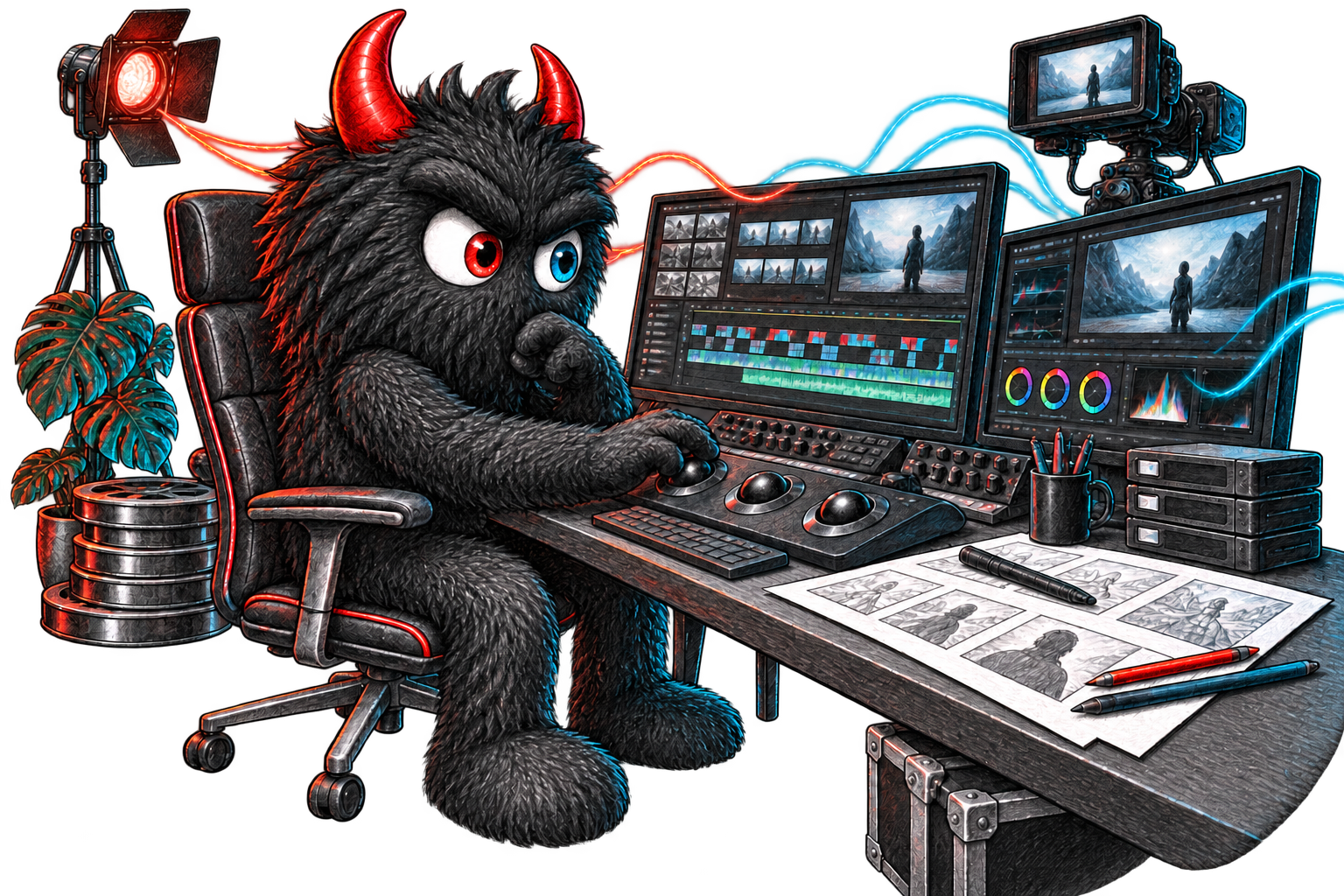
Adobe's updated Firefly experience brings image and video generation, project assets, generation history and video timelines into one beta workspace. Its September updates include video background removal, while Premiere's Generative Extend can add frames or ambient audio to cover a transition, hold a reaction or repair an awkward movement. Avid also announced browser-based Media Composer and agentic creative workflows with Google Cloud. The industry is moving from generating clips beside the edit to using AI throughout the production process.
What pioneering actually means at OMG
Pioneering does not mean placing every new model into a client project the day it launches. It means learning early enough to understand where the capability is real, where it breaks and how it should be governed before the market turns it into a checklist item. Brad Nietfeldt's background as an early PayPal IT team member, an eBay lead developer and the founder of OMG in 2003 shaped that approach. New technology earns its place by improving the system, not by making the proposal sound current.[2]
At OMG and Monstrous Media Group, the work begins with the production decision. What must the audience understand? Which source material is authoritative? What visual rules define the brand? Which actions may the model take? Where must a person approve the result? We then connect the appropriate reasoning, image, video and application tools around those answers. The result can accelerate exploration and production without surrendering authorship, quality or accountability.
A modern image and video pipeline needs more than prompts
A dependable pipeline starts with structured inputs: an approved brief, brand rules, reference assets, usage rights, audience definitions and delivery specifications. It continues with repeatable prompt patterns, versioned source material, model selection, generation records and review gates. Image output must be checked at the size and crop where it will actually appear. Video output needs continuity, motion, sound, captions, aspect-ratio versions and an editorial reason to exist.[3]
The workflow should also preserve a path back to human tools. Designers need editable files, editors need a timeline, developers need predictable media delivery and marketers need metadata that travels with the asset. AI can create options, remove repetitive labor and help teams find the useful moment faster. It should not leave the organization with an untraceable pile of generated files that nobody can confidently revise or reuse.
The gains for web design, applications and search
For web design, stronger image editing makes it easier to build original visual systems rather than settling for generic stock photography or disconnected generated art. For application development, stronger reasoning and computer use improve the ability to analyze workflows, prototype interfaces, test behavior and maintain complex systems. For video, better analysis and editing create a practical path from a long recording or asset library to focused stories for a website, social channel, sales presentation or internal training program.[4]
These capabilities also support SEO, AEO and GEO when they are connected to real expertise. A model can help map an organization's entities, services, questions, proof and media into a coherent publishing system. Images and video can reinforce the same topic architecture through accurate captions, transcripts, descriptive metadata and accessible alternatives. The goal is not to manufacture volume. It is to create a stronger, more consistent body of evidence that people and answer systems can understand.
The risks have become more operational, not less
Better output can make errors harder to notice. A realistic image may still misrepresent a product. A polished video may introduce a continuity failure, an unauthorized likeness or a factual claim that was never approved. An agent may complete the wrong task efficiently. Organizations need provenance, rights review, privacy controls, disclosure policies, security boundaries and clear ownership of the final decision. C2PA metadata and watermarking can support transparency, but they do not replace internal accountability.[5]
Cost also shifts as workflows become multimodal and iterative. The relevant number is not the advertised price of one generation. It is the cost of creating, reviewing, correcting, storing, delivering and maintaining a usable asset. OMG measures successful outcomes, correction time, human effort, latency and reuse. That reveals whether the technology created leverage or merely moved labor into a less visible part of the process.
The next advantage belongs to connected creative systems
The market will continue to produce impressive models. The durable advantage belongs to organizations that connect those models to their own standards, knowledge and customer experience. Astra can reason and operate. Fable 5.1 can sustain difficult work at improved economics. Images 2.5 can hold a visual direction through more precise revisions. Emerging video tools can understand footage and participate in the edit. None of them knows what your brand should mean unless experienced people define it.[1]
OMG is helping seasoned businesses turn that possibility into a working production system. We combine founder-led creative direction, application engineering, search strategy and governed AI implementation so every new capability has a purpose and every finished experience still feels unmistakably human. The tools are moving quickly. The standard should move higher with them.