Why did OMG leave Adobe Creative Cloud?
As of November 1, 2026, Omaha Media Group has ended its Adobe subscription. For our studio, Creative Cloud had become too expensive, too heavy and too restrictive for the way modern creative production now works. We no longer believe we should rent a large closed bundle to reach the handful of tools we need, especially when open-source local applications and flexible AI production systems give us more control over our files, models, workflow and costs.[1]
ArtCraft has already replaced meaningful parts of our Adobe workflow, including image generation, compositing, background work, rapid concept development and selected editing tasks. It gives us open-source native applications, local file control, agent-ready automation and an AI studio that brings current image and video models into one visual workspace. The software has changed, but our standard has not. The trained eye, design judgment and finishing discipline still determine whether the result deserves to ship.
What ArtCraft actually includes
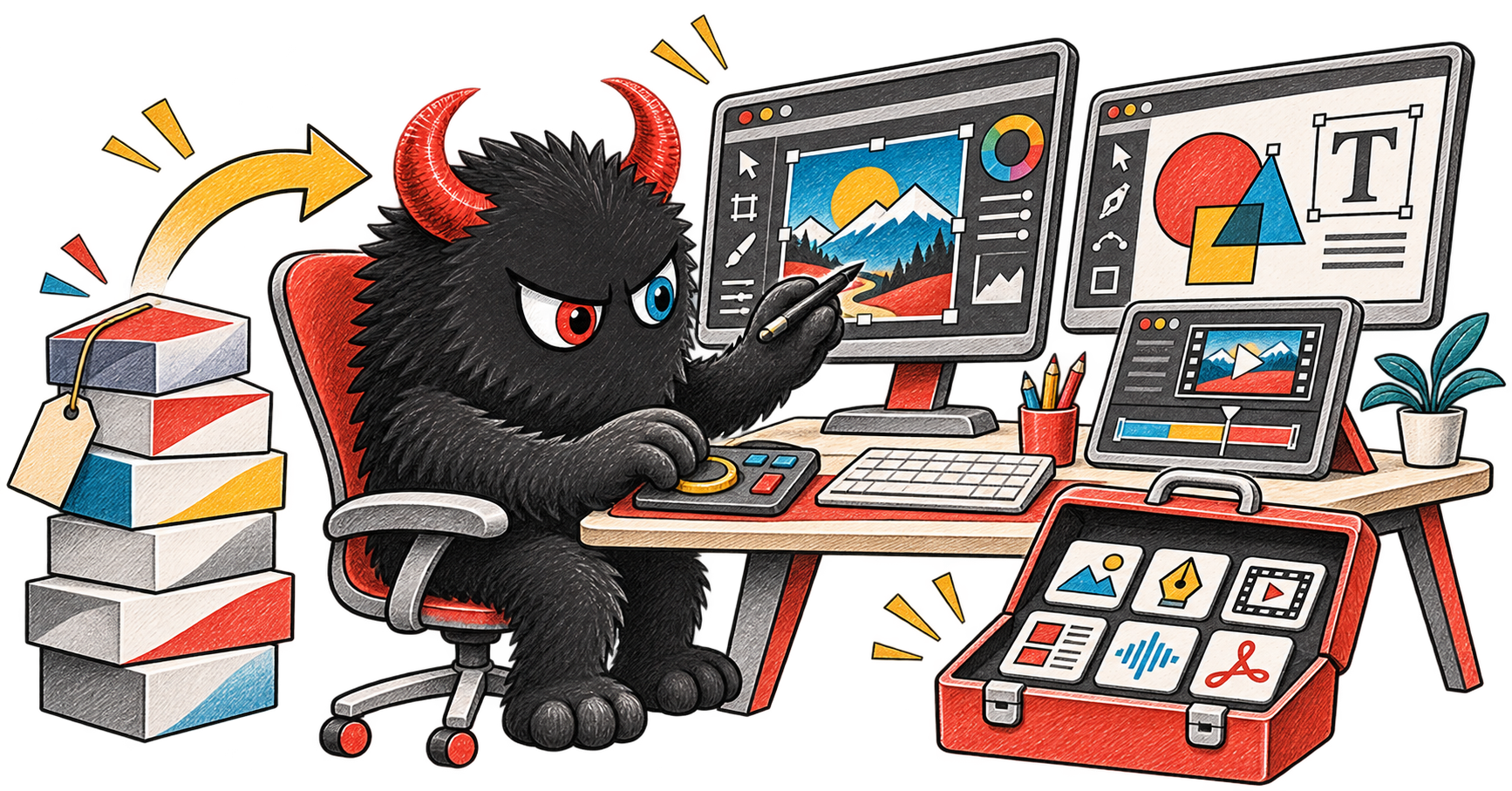
ArtCraft is really two connected product ideas. ArtCraft Studio is its generative image and video environment, available on desktop and the web. The Crafting Apps are a broader family of native, open-source tools spanning image editing, vector illustration, video, photo management and raw development, PDFs, motion graphics, page layout, interface design, 3D texturing, procedural materials, word processing, audio, presentations, computer-aided design, spreadsheets and software exploration. The ArtCraft Launcher installs the applications and keeps them current.[2]
The lineup is ambitious, and its maturity varies. PhotoCraft, PdfCraft, FigCraft and Craft Anything are identified as early alpha releases, while many other applications remain in development. That matters. A studio should not confuse a compelling roadmap with complete production parity. We currently treat the suite as a rapidly advancing creative system, evaluate each app against the exact assignment, and preserve reliable fallback paths for specialized or mission-critical deliverables.
Why the local-first architecture matters
The Crafting Apps are written in Rust and designed as native applications for macOS, Windows and Linux rather than desktop wrappers around a website. ArtCraft says the tools operate on local files, publish their code under permissive open-source licenses and expose command-line, JSON and MCP control surfaces for automation and AI agents. Many of the applications also compile to WebAssembly for use in a browser. That combination is unusually relevant to how modern studios actually work.[3]
Local-first does not automatically mean private, secure or production-ready in every scenario, and teams still need to review model providers, file handling and organizational policy. It does mean the creative application itself can remain close to the files and the operator. Open code makes the system inspectable. Agent-ready interfaces create opportunities to automate repetitive production without turning the visual decision over to a chatbot. For OMG, those qualities align with the custom systems we build: own the workflow, understand the dependencies and keep human review at the center.
ArtCraft Studio gives artists more than a prompt box
The strongest part of ArtCraft Studio is its emphasis on composition before generation. A user can build a scene with images, cutouts, foreground elements, backdrops and 3D assets, establish depth, pose a character and then use a selected model to render the result. The workspace also includes background removal, two-dimensional compositing, image-to-location tools, image-to-3D mesh conversion and mixed-asset scenes. This is closer to directing a shot than repeatedly rewriting a prompt and hoping the model guesses correctly.[4]
That distinction is central to professional creative work. Brands need recurring characters, deliberate framing, usable negative space, accurate crops and visual continuity across channels. A model may create a striking image, but the studio needs control over where the subject stands, what the camera sees and which details survive the next variation. ArtCraft gives us a practical layer between intention and generation. We can rough in the composition, test multiple models and then finish the selected result with the same critical standards we apply to conventional production.
One workspace can reach many current AI models
ArtCraft currently lists image access across models and services including Flux variants, Nano Banana, GPT Image, Seedream and editing-focused models. Its video list includes Kling, Seedance, Sora and Google Veo variants. The exact catalog will change because model availability, versions and provider policies move quickly. The strategic value is not any single model. It is the ability to choose a model according to the shot, edit, speed, fidelity and budget instead of rebuilding the entire workflow around one vendor.[5]
OMG uses that flexibility as a production advantage. One model may be stronger at maintaining a product, another at typography, another at a cinematic camera move and another at precise image editing. We compare outputs inside the needs of the brand rather than declaring one universal winner. Source assets, approved references and finished masters remain organized outside the model. This model-flexible approach reduces lock-in and helps us continue a project when a provider changes pricing, retires a version or introduces a stronger capability.
A respectful goodbye to Adobe
Leaving Adobe does not erase what its applications meant to us. Photoshop has been part of Brad's creative life from childhood experiments through decades of professional design, development and the current Creative Cloud era. Adobe helped define the language of digital creativity for generations of designers, including ours. We will always remember that fandom, the discoveries inside Photoshop and the countless ideas its tools helped us bring into the world.[6]
This is a breakup, not a grudge. Adobe remains a mature professional ecosystem and continues to expand AI assistants across Firefly, Photoshop, Premiere, Illustrator, InDesign and Frame.io. Its direction will still influence the industry. It simply no longer fits OMG's production philosophy or economics. We wish everyone at Adobe well, and we are grateful for the long creative history, but our future is a lighter, more flexible stack that we can run locally, adapt openly and shape around the work instead of the subscription bundle.
What our first month changed at OMG
The immediate change was speed with control. ArtCraft became a working surface for original blog illustrations, concept imagery, scene blocking, visual experimentation, background removal and image-to-video tests. Instead of moving between disconnected generators, download folders and temporary editing utilities, we could keep more of the exploration around a shared composition. That made it easier to compare alternatives, protect the core idea and decide which result deserved additional finishing.[1]
The larger change was creative confidence. A lower-cost, open system makes it easier to experiment without treating every attempt as a metered decision. More attempts do not guarantee better design, but they give an experienced director more material to judge. Brad Nietfeldt's background in design, development and complex digital systems shapes how OMG uses these tools. We are not looking for a button that replaces craft. We are building a production environment where software removes friction and the human eye has more room to pursue the uncommon idea.
The risks are real, and manageable
Early software changes quickly. Features can be incomplete, interfaces can move and an export path that works for one project may not satisfy another. AI model use introduces additional questions about rights, provenance, confidentiality, training data, third-party terms and appropriate disclosure. Open source improves inspectability but does not remove the need for security review, backups, controlled updates and documented approval. Free software can also carry an operational cost when a team must solve problems that a mature vendor already handles.[2]
Our response is governance, not fear. We separate experiments from critical production, keep editable source material, document important model and licensing decisions, review outputs for anatomy and factual errors, and validate every final format. Client-sensitive inputs only enter approved environments. Accessibility, performance and content rights remain part of release review. The tool can change, but the studio standard does not. That discipline is what turns new software into a responsible capability rather than another novelty layer.
A practical migration plan for creative teams
OMG did not cancel on impulse. We spent a month using ArtCraft almost exclusively, mapped the work we actually perform and tested the replacement path through real visual production. A team considering the same move should begin with image cleanup, illustration, layout, social production, video editing, motion, PDFs, raw photography, interface design and review. Reproduce recurring assignments, then compare setup time, editing precision, output quality, file ownership, accessibility, export behavior and total correction time.[3]
Decide at the capability level and preserve a way to open important archives. A team may replace background removal and concept compositing immediately, keep a specialized commercial tool for long-form print or test FilmCraft as it matures. OMG concluded that the Creative Cloud subscription itself no longer deserved a place in our stack. The goal is not ideological purity. It is a durable production system that matches the work, protects the brand and gives skilled people control.
The new creative advantage is optionality
Creative software is becoming less like a fixed toolbox and more like an adaptable production system. Native open-source applications can work beside browser tools. AI models can enter through multiple interfaces. MCP and command channels can automate repeatable operations. Artists can own more of the stack while still using commercial software where it provides the strongest result. That optionality changes cost, resilience and the pace at which a small senior team can explore.[4]
For OMG clients, the value appears in the finished work: more original concepts, faster visual development, better-controlled variations and fewer reasons to settle for stock. We bring the same standard whether a file begins in ArtCraft or another specialized local tool. The software should expand what experienced people can make, not become the story people notice. After our first month, ArtCraft has become a central part of the system that replaced Adobe, and we expect its open, agent-ready approach to influence what professional creative software becomes next.