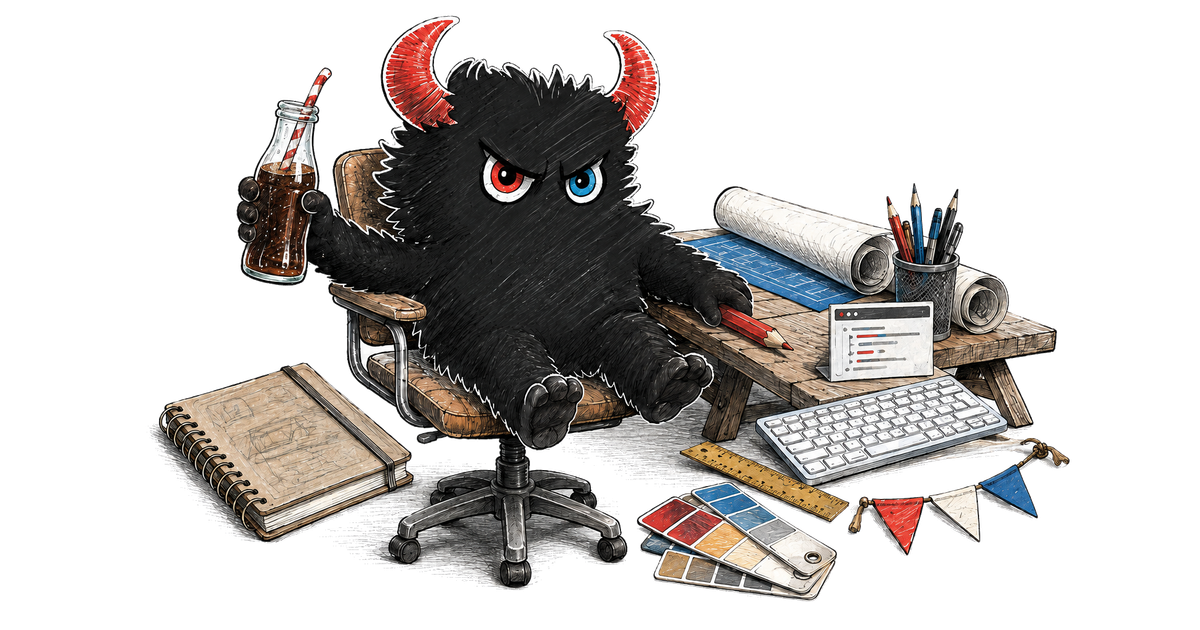
A day for the people who make things possible
Labor Day is an annual celebration of the social and economic achievements of American workers. Its roots reach back to the late nineteenth century, when labor advocates called for a holiday recognizing the people whose effort built the country's strength, prosperity and well-being. The first celebration took place in New York City on September 5, 1882, and Congress made the first Monday in September a legal holiday in 1894.[1]
That history matters because finished work has a way of hiding the labor behind it. A building looks inevitable once the scaffolding is gone. A useful website feels simple after thousands of decisions have been resolved. A brand appears confident after the uncertainty, sketches, rejected directions, technical constraints and careful revisions have disappeared from view. Today is a good day to notice all of it.
Digital work is still human work
The tools on a modern desk may look different from those used by the machinists, carpenters, printers and other tradespeople who shaped the early labor movement, but the essential act remains recognizable. Someone studies a problem, develops a skill, makes choices, tests the result and accepts responsibility for the quality of what leaves the workshop. Design and software are not weightless simply because their materials are pixels, systems and code.[2]
Every polished digital experience carries the work of strategists, writers, designers, developers, accessibility specialists, infrastructure teams, search professionals, account leaders and the people inside the client organization who contribute hard-earned knowledge. The best results happen when those people are treated as thinkers and collaborators, not interchangeable production capacity. Talent grows through trust, clear expectations, useful feedback and enough room to do the job properly.
Craft is attention made visible
At Omaha Media Group, craft means caring about details before anyone asks whether they matter. It is the spacing that makes a paragraph comfortable to read, the error state that helps a customer recover, the redirect that protects years of search equity, the image treatment that respects a brand and the administrative workflow that lets a team maintain the experience after launch. These choices rarely become launch-day headlines, but together they determine whether the work feels dependable.[3]
Brad Nietfeldt founded OMG in 2003 around the belief that design, development and problem-solving belong together. His early experience at PayPal and as a lead developer at eBay reinforced a practical standard: the visible experience and the system beneath it must support each other. Twenty-three years later, the technologies have changed dramatically, but the respect for skilled work has not.
Good technology should extend people, not erase them
Artificial intelligence is changing how knowledge work is researched, produced, tested and maintained. Used well, it can remove repetition, reveal patterns, accelerate exploration and give experienced people more time for judgment. Used carelessly, it can flatten expertise into generic output, disguise uncertainty and create more work for the people expected to correct it. The difference is not the novelty of the model. It is the quality of the system and the intentions of the people operating it.[4]
NIST's human-centered AI work keeps human goals at the center of how AI uses are categorized and evaluated. That principle aligns with our own application-development standard. We define what the technology may do, what evidence it must provide, when a person must review the result and which actions require explicit approval. Automation should make skilled people more capable. It should never become an excuse to stop valuing the experience that makes the outcome trustworthy.
Rest belongs inside sustainable work
Labor Day is also a reminder that sustainable performance cannot be separated from well-being. The National Institute for Occupational Safety and Health describes Total Worker Health as an approach that combines protection from work-related hazards with practices that advance worker well-being. Its guidance recognizes that the design of work itself affects safety, health, creativity, retention and the ability to contribute over time.[1]
Creative and technical fields sometimes romanticize exhaustion, late nights and constant availability. Urgent moments happen, especially during complex launches, but permanent urgency is not a culture of excellence. Strong teams plan, document, communicate and build enough resilience into their systems that every success does not require a crisis. Rest is not the opposite of ambition. It is part of protecting the judgment and curiosity that ambitious work requires.
Productivity is more than output
The Bureau of Labor Statistics reports labor productivity as output per hour worked. In the second quarter of 2026, nonfarm business labor productivity increased 2.2 percent from the same quarter a year earlier. The number is useful, but leaders should be careful about translating productivity into a demand for more visible activity. More messages, meetings, pages, campaigns or lines of code do not automatically produce a better business outcome.[2]
For a design studio, meaningful productivity is progress toward the right result. It may look like discovering a flawed assumption before development begins, simplifying a customer journey, creating a reusable component, writing documentation that prevents future confusion or deciding not to build a feature that would add cost without adding value. Experienced work often creates leverage by removing unnecessary work.
Respect the knowledge closest to the work
The person doing the work usually sees realities that are invisible from a distant dashboard. Customer-service teams hear the questions that marketing language failed to answer. Developers know which shortcuts will become recurring failures. Designers notice when a system cannot support the content it is supposed to communicate. Sales teams recognize the proof a serious buyer needs before moving forward. Good leadership creates ways for that knowledge to shape decisions.[3]
This is one reason OMG keeps senior creative and technical leadership close to special projects. Fewer handoffs preserve context, and direct collaboration makes it easier to test an idea against business needs, customer behavior and implementation reality at the same time. The goal is not to make one person the source of every answer. It is to give the people with relevant experience a meaningful place in the decision.
Celebrate the work nobody sees
Today we are grateful for the visible makers and the quiet operators. We celebrate the people who sketch the first idea, organize the files, challenge the brief, check the contrast, test the form, secure the environment, answer the customer, reconcile the invoice, clean the workspace and make sure the next person can continue without starting over. Organizations become dependable through thousands of acts that are easy to overlook individually.[4]
We are especially thankful for the clients who treat creative and technical teams as partners. The strongest work comes from honest conversations, timely decisions, shared accountability and respect for the difficulty of doing something original well. A serious budget matters, but so do attention, access and trust. Those conditions give skilled people the ability to contribute their best thinking instead of merely completing a list of instructions.
What we carry back into the studio
After the holiday, the pencils will be sharp again. We will return to the same questions that guide our best work: What problem are we truly solving? Who needs this experience to work? What evidence supports the decision? What can be made clearer, faster, more accessible and more memorable? Which technology genuinely helps, and where does a human need to remain firmly in charge?[1]
Those questions keep the work grounded while the tools move quickly. They also connect brand design, websites, applications, search, automation and infrastructure into one practice. The deliverables may be different, but each one is an opportunity to respect the people who will use it and the people responsible for keeping it useful.
Happy Labor Day from Omaha Media Group
To the builders, makers, caregivers, operators, technicians, teachers, drivers, tradespeople, entrepreneurs, artists, developers and problem-solvers who keep communities and companies moving, thank you. To our collaborators and clients in Omaha and around the world, thank you for trusting us with work that matters. We hope today includes good people, good food and a genuine break from the notifications.[2]
Great work is never only the object at the end. It is the experience, patience, care and human effort invested along the way. That is worth celebrating today, and it is worth respecting every other day of the year. Happy Labor Day from Brad and the whole Omaha Media Group family.