What changed in AI web design this week?
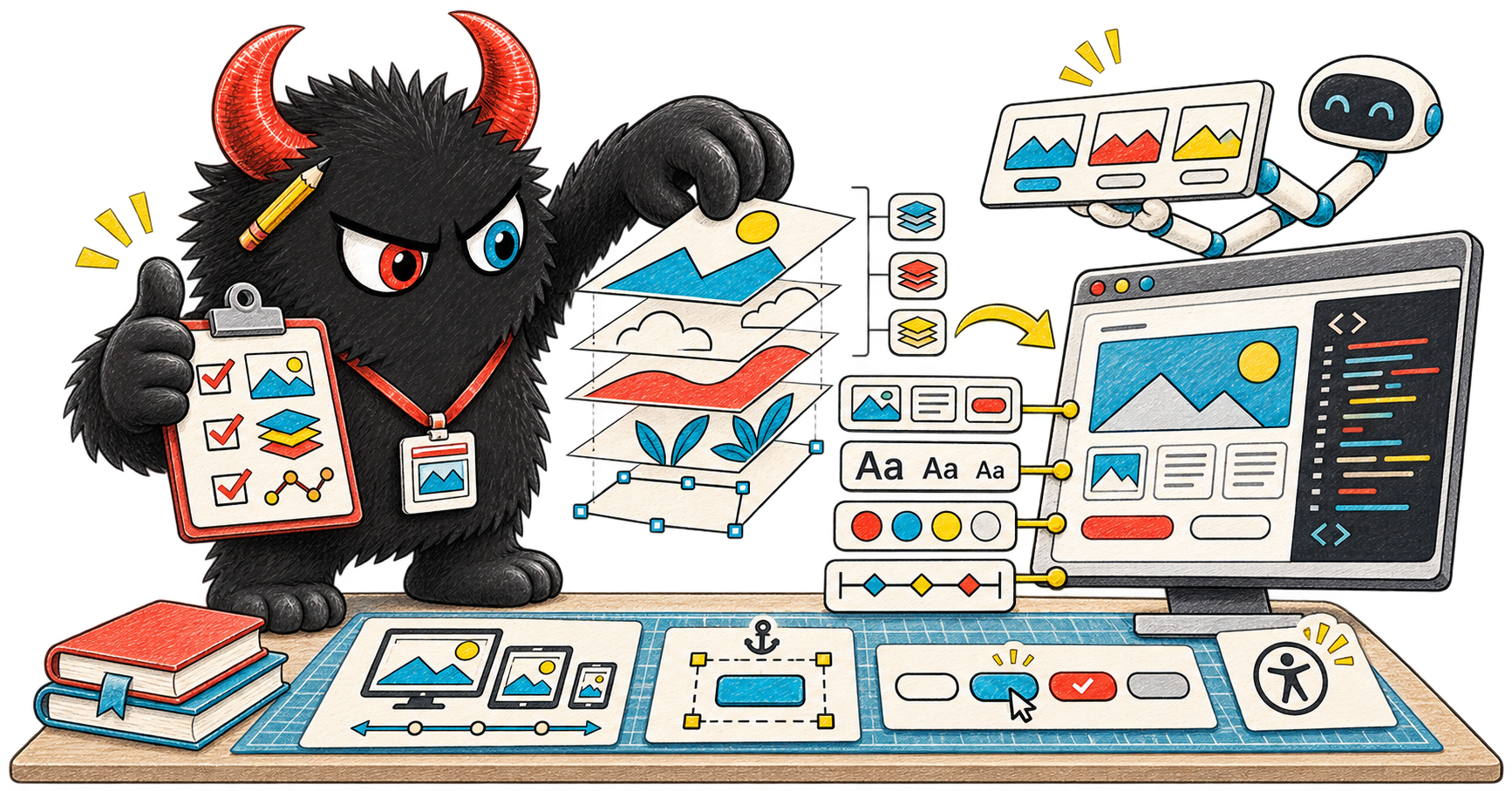
AI web design is moving beyond prompt-generated screenshots and disposable prototypes. Figma's November 2026 releases let its agent produce editable vector illustrations and icons with functional layer groups, real strokes, attached style references and structures prepared for animation. Figma is also using prototype connections as context for code layers. At the same time, Chrome DevTools for agents can inspect computed and matched CSS, inherited rules, pseudo-elements, keyframes and modern at-rules. Together, these advances signal a practical shift: AI can begin working with the actual structure of design and development instead of only imitating the final surface.[1]
That does not make the designer optional. It makes direction, systems thinking and review more valuable. Someone still defines the brand, decides which visual choices belong together, controls accessibility, protects performance and recognizes when an attractive output solves the wrong problem. Omaha Media Group combines Brad Nietfeldt's decades of design and development experience with agent-readable tools, custom code and current creative AI. The goal is not to generate more screens. It is to build a coherent digital system that can be edited, understood, maintained and trusted after launch.
The flat AI mockup was always a dead end
A flattened mockup can communicate a mood, but it does not contain the decisions required to build a website. The typography may not correspond to available fonts. Spacing may change randomly from one card to the next. Components that look related may have no shared behavior. Responsive states, hover states, focus indicators, validation, reduced motion and content growth are usually missing. The image can inspire a conversation, but a development team must reverse-engineer nearly everything that makes it usable.[2]
This is why many AI website demonstrations feel impressive for thirty seconds and frustrating for the next thirty days. They optimize the reveal instead of the operating system. OMG treats visual exploration as an input, not the deliverable. We identify the useful idea, translate it into type, spacing, color, media, motion and component rules, and test those rules across real content. A production website needs enough consistency to become recognizable and enough flexibility to handle what the business publishes next.
Editable vectors turn generation into design material
Figma's agent-generated vectors now arrive with independently editable groups and strokes that behave like strokes rather than expanded shapes. Designers can attach existing illustrations as references, generate related components in a recognizable style, adjust line weight and end caps, and prepare the layer structure for motion. These details sound small until a team tries to maintain a visual language across dozens of pages, campaigns, breakpoints and animated states.[1]
A professional does not need an AI image that merely resembles an icon. The professional needs an asset that can be corrected, recolored, scaled, animated and handed to another person without starting over. Editability preserves judgment. It allows a designer to keep the strong idea, remove the generic parts and bring the result back into the brand. OMG uses generative output this way across custom illustration, concept art and digital interfaces. The model contributes material. The studio decides what survives.
Brand references are useful only when the system is real
Attaching a style reference can improve continuity, but a reference image is not a complete design system. A brand also has rules for hierarchy, contrast, voice, image selection, spacing, responsive behavior, motion, accessibility and when to break its own patterns. Those rules often live across source files, production code, editorial practice and the experience of the people who have protected the identity over time.[4]
OMG builds a source of truth that agents and people can both use. Design tokens encode repeatable values. Components define structure and interaction. Content models preserve meaning. Approved media and visual references establish the range. Accessibility requirements set non-negotiable boundaries. The system then gives AI useful context without asking it to invent the brand on every request. This is the difference between generating something in the right colors and producing work that actually feels like the organization.
Prototype connections are becoming design intent
Figma's November update also lets prototype connections inform code layers. A connection between two frames is no longer only a presentation trick. It can become evidence about what an interaction is supposed to do. That matters because static screens leave important questions unanswered: whether an element replaces content or opens a layer, how navigation preserves context, what the back action means and how a sequence should respond when data is incomplete.[1]
A prototype still cannot describe every production condition, but richer context reduces translation loss between design and development. OMG has always worked across that boundary. Brad's background as both a designer and lead developer means the interaction is considered as a visual, technical and operational decision at the same time. We use prototypes to test meaning and flow, then implement the behavior with semantic HTML, resilient state management, accessible controls and the performance appropriate to the moment.
Chrome is making the built website legible to agents
Chrome's November DevTools update gives coding agents a structured way to inspect CSS styles, including matched and computed values, inherited rules, pseudo-elements, keyframes and newer constructs such as position fallbacks and custom properties. Chrome also added visual tooling for CSS anchor positioning. An agent can now understand more of why an element appears where it does, while a human developer can inspect and correct the same system through familiar browser tools.[3]
This is more important than another prompt-to-page generator. The browser is the place where the designed system meets real content, devices and user preferences. Agent-readable inspection can help diagnose a broken cascade, trace an inherited value, understand motion or identify which rule controls a responsive state. OMG sees this as an extension of professional development, not autonomous permission to rewrite a production interface. The agent accelerates investigation. An experienced developer decides what should change and verifies the result.
Agentic design needs guardrails, history and review
When an agent can change components, content and code, speed is not the only requirement. A production system needs clear authority, bounded tools, version history, approval and a path back. Teams should know what changed, who requested it, which source informed it and whether tests passed. Webflow's 2026 agent announcements emphasize similar concerns by pairing broader MCP access with visibility and review around agent activity.[4]
OMG applies those principles to our own CMS, forms, content interfaces and WebMCP tools. Read-only discovery is separated from actions that create data. A contact submission requires explicit confirmation. Published content is separated from drafts and deleted records. Deployments are validated before they reach the public domain. The same thinking belongs in AI-assisted design: give the system enough context to help, limit what it can change, and keep an accountable human responsible for the release.
Accessibility cannot be inferred from appearance
An AI-generated interface may look clean while failing keyboard navigation, text scaling, focus order, contrast, error identification or reduced-motion preferences. Accessibility lives in markup, behavior, language and testing, not just the screenshot. Editable layers and code-aware agents create better conditions for correction, but they do not guarantee conformance or a usable experience for people with disabilities.[5]
OMG includes accessibility in the design system and development standard. We use semantic structures, visible focus, accessible names, adaptable layouts and meaningful alternatives for media. We test critical paths with keyboards and assistive-technology expectations, and we preserve user preferences when motion or visual effects are not essential. AI can help inspect patterns and produce variations. Human review must confirm that the experience works beyond the ideal pointer, viewport and content sample.
Production-ready means the content can change
A polished homepage is not proof of a production-ready website. The system must survive longer headlines, missing images, new service categories, translated content, campaign pages, search results, forms, errors and the smaller surfaces that answer engines quote. It also needs clear metadata, canonical URLs, structured data and internal relationships that remain accurate when content changes.[6]
OMG connects design to the publishing system beneath it. Our CMS models content according to meaning rather than locking it into one visual arrangement. The site exposes approved information through search, `llms.txt`, entity maps, JSON APIs, MCP and browser-native WebMCP tools. That structure helps search engines and AI systems understand what the organization offers and which source should be cited. A design system controls the presentation, while a content system preserves the truth that presentation is built to communicate.
How businesses should evaluate AI web design tools
Ask what remains editable after generation. Inspect whether components share variables and behavior, whether vectors contain useful layers, whether interactions carry intent and whether the exported code is semantic and maintainable. Test responsive states, keyboard use, zoom, content changes and performance. Confirm that source files, data and generated assets remain portable. A fast prototype is valuable only if it reduces uncertainty instead of creating an expensive reconstruction project.[4]
Then evaluate the people and process around the tool. Who defines the design direction? Who reviews brand continuity? Who understands the production framework, accessibility obligations, analytics, search migration and long-term stewardship? AI increases output, which makes disciplined selection more important. The best partner will not sell the tool as the strategy. They will show how the tool supports a clear business decision and how experienced people remain accountable for the outcome.
The future is human-directed and system-aware
The useful future of AI web design is not a machine inventing a homepage in isolation. It is a connected workflow where an agent can understand approved visual references, editable layers, prototype intent, component rules, production CSS, content relationships and release constraints. Each improvement reduces the waste between idea and implementation. None of them eliminates the need for taste, empathy or technical judgment.[5]
That is where OMG is positioned. We combine award-winning creative direction, custom web and application development, AI-assisted image and video production, accessibility, search strategy and agent-readable infrastructure inside one founder-led studio. The tools are finally becoming capable of working with real systems. Our job is to make sure those systems express something original, serve the people using them and remain strong long after the first impressive demo.